
Rent a Car in Javea (Xabia): Your Complete 2026 Guide to Costa Blanca's Hidden Gem
When you decide to rent a car in Javea, you unlock a side of the Costa Blanca that most package tourists never see. This whitewashed town on the northern Costa Blanca, known locally as Xabia, is split across three distinct districts, surrounded by the rugged Montgo Natural Park, and dotted with cliffside lighthouses, hidden coves, and mountain villages that reward drivers far more than they reward bus passengers. Without your own wheels, you will spend most of your trip on a single beach. With a car, you can wake up in the Old Town, swim at Cala Granadella before lunch, drive up to Cap de la Nao for sunset, and finish the day with grilled fish at the Port. That is the real Javea experience, and this guide explains exactly how to make it happen.
Javea has roughly 27,000 residents, and around half of them are foreign nationals, with the British community making up close to 29 percent of the population. That international flavor shapes everything from menus in English to bilingual road signage, but it does not change one fundamental truth: the area was built for the car, and the most beautiful corners sit outside the town center. Whether you are flying into Alicante Airport or Valencia Airport, this guide walks you through routes, areas, parking, costs, expat-tested driving tips, and the best road-trip ideas for your stay.
Why You Need a Rental Car in Javea
Javea is technically served by public transport, but in practice, buses between the three main areas of town are infrequent, taxis add up fast, and there is no train station inside the municipality. The closest railway station is in Gata de Gorgos, around 8 kilometers inland, with limited connections. If you want to actually explore the Costa Blanca North, a rental car is not a luxury, it is the difference between seeing Javea and visiting Javea.
The reasons most travelers rent are practical and consistent:
- Distance between districts. The Old Town, the Port, and the Arenal beach area are not within comfortable walking distance of each other. The Old Town sits roughly 2.5 kilometers from the Port and almost 4 kilometers from Arenal, with hills in between.
- Coastal access. Many of Javea's most famous coves, including Cala Granadella, Cala Portichol, and Cala Sardinera, are reached by narrow access roads that no bus serves.
- Mountain access. The Montgo Natural Park and the lighthouse routes require driving up winding cliffside roads, often with limited parking that fills early in summer.
- Day trips. Calpe, Moraira, Denia, Altea, Guadalest, and even Valencia or Alicante city are all within reach for a single-day outing, but only if you control your own schedule.
- Grocery and inland villages. Most large supermarkets, garden centers, and authentic Spanish inland villages such as Jesus Pobre, Lliber, and Jalon (Xalo) sit a short drive away.
If you are traveling with family, with diving or surfing gear, or planning to villa-hop along the coast, the case for renting becomes even stronger. The good news is that competition is healthy and prices are reasonable, especially in the shoulder seasons of April, May, October, and November.
Understanding Javea's Three Areas Before You Drive
One of the most useful things to understand before you collect your rental car is that Javea is not a single town. It is three distinct districts, each with its own character, road layout, and parking culture. Where you stay and where you drive determines a huge part of your experience.
The Old Town (Javea Pueblo)
The Old Town is the historical heart of Javea, set back from the coast on slightly higher ground. It is a maze of narrow, whitewashed streets centered around the Gothic church of San Bartolome, with a bustling indoor market (Mercado de Abastos), traditional tapas bars, and weekly outdoor markets on Thursdays. The streets here are tight, often one-way, and parking on the street is mostly residential.
For drivers, the rule of thumb is simple: do not try to drive into the historical core. Park at one of the perimeter lots, especially the area around Mercado de Abastos or the larger open-air parking by the bullring, and walk in. A smaller rental car will save you stress here, even if your group is large enough to justify an SUV.
The Port (Javea Puerto)
The Port sits about 2.5 kilometers from the Old Town and runs along a sheltered harbor that is still home to a working fishing fleet. The fish auction (lonja) brings boats in once a day, and the surrounding restaurants serve some of the freshest seafood on the coast. The Port is also where many beachfront and seafront hotels are located.
Driving through the Port is far easier than the Old Town: the roads are wider, parking lots are larger, and the seafront promenade is well-signposted. In high season (July and August), expect parking near the harbor to fill before 11 am.
Playa del Arenal
The Arenal is Javea's golden-sand main beach and the most resort-style area. It is lined with restaurants, beach bars, ice cream parlors, and family-friendly hotels. Most of the British and Northern European visitors gravitate here, especially families with younger children.
The Arenal has the easiest parking infrastructure of the three areas, with large municipal lots set back one block from the promenade. From Arenal, the coastal road that climbs south toward Cap de la Nao and Cala Granadella is one of the most scenic drives in the entire Costa Blanca.
How to Reach Javea: Alicante vs Valencia Airport Pickup
Javea sits roughly halfway between Spain's two largest Mediterranean airports, which gives you flexibility on where to land and where to collect your rental car. The right choice depends on flight prices, arrival time, and how much driving you want to do on day one.
From Alicante-Elche Airport (ALC), the drive to Javea is around 90 kilometers and takes between 1 hour and 1 hour 20 minutes via the AP-7 motorway. The AP-7 is no longer a tolled stretch in this section, which has made the Alicante route significantly more attractive than it was a few years ago. You exit at Junction 62 (Javea/Benitachell) and follow the CV-735 directly into town. For most travelers from the UK, Ireland, and Northern Europe, Alicante offers the widest flight selection and the simplest motorway connection. Many car rental customers prefer the convenience of picking up directly at Alicante Airport where dedicated parking and airport pickup services are in place.
From Valencia Airport (VLC), the drive is around 110 kilometers and takes between 1 hour 15 minutes and 1 hour 30 minutes, also along the AP-7. Valencia is a great option if you are arriving from Central Europe, if flight prices are dramatically lower, or if you want to start your trip with a day or two in Valencia city before driving south.
If your rental company offers free door-to-door delivery, you can also have the car waiting for you at your villa or hotel in Javea. Our Costa Blanca fleet includes complimentary delivery from both Alicante and Valencia airports, which removes the stress of finding a rental desk after a long flight and lets you skip the airport rental queue entirely.
What to Drive: Choosing the Right Rental Car for Javea
The vehicle that works for a Madrid city break does not necessarily work for the Costa Blanca North. Javea's mix of narrow Old Town lanes, steep cliff roads, and long motorway day trips means that the right rental car is the one that matches both your group size and your itinerary.
A few practical recommendations based on real-world driving in the area:
- Compact hatchbacks (Peugeot 208, Opel Corsa, VW Polo). The sweet spot for two adults. Easy to park in the Old Town, sip fuel on long drives, and fit on tight coastal access roads.
- Family hatchbacks (Peugeot 308, Opel Astra, Toyota Auris). Comfortable for two adults and two children, with enough boot space for beach gear and a couple of suitcases. A good all-rounder if you plan motorway day trips.
- Compact SUVs (Peugeot 2008, Renault Captur). Slightly higher ground clearance helps with steep villa driveways and unpaved tracks near the inland villages. Pricier to park in the Old Town.
- Hybrids (Toyota Auris Hybrid, Lexus CT200h). An excellent choice if you plan a lot of city stop-and-go driving in Denia, Calpe, or Valencia. Fuel savings add up quickly.
- Automatic transmissions. Manual is the default in Spain and automatic stock is limited, so book early if you need an auto. Expect a 20 to 40 percent price premium versus a comparable manual.
If you are unsure, the safe answer for most Costa Blanca trips is a family-sized hatchback. It handles the Old Town better than a large SUV, has enough room for luggage and a beach day, and stays comfortable on a 90-minute motorway run to the airport.
Driving Around Javea: Roads, Parking, and Local Quirks
The driving culture in Javea is more relaxed than in inland Spain, but it has its own habits, especially in summer. The town's large British and Northern European community means signage is generally easy to follow, but local etiquette can still surprise first-time visitors.
A few things worth knowing before you turn the key:
- Indicators are optional. Many local drivers do not signal on roundabouts. Approach every roundabout assuming the car next to you might cut across your lane.
- Zebra crossings are sacred. Unlike in some Spanish cities, drivers in Javea actually stop. If you are at the wheel, expect to do the same, even when the pedestrian is still on the kerb.
- Parking colors matter. Blue lines mean pay-and-display (paid parking), white lines mean free parking, and yellow lines mean no stopping. Green lines, where they exist, are usually reserved for residents.
- Old Town width. Some streets in the historical center are narrower than they look on the map. If you take a wrong turn, do not hesitate to reverse out rather than scrape your wing mirror.
- Speed limits. Urban areas are 30 to 50 km/h, secondary roads are 90 km/h, and the AP-7 motorway is 120 km/h. Speed cameras (radares) are common and tickets follow you home.
- Beach traffic in August. The road to Arenal and the road south toward Cap de la Nao both develop slow traffic between 10 am and noon in peak season. Drive early or late to avoid it.
- Driving licenses. EU licenses are valid as-is. UK and Northern Irish licenses are accepted for short visits. Non-EU visitors from outside the EEA should bring an International Driving Permit alongside their national license.
For UK drivers in particular, the biggest mental shift is the right-hand-drive change. Most British expats report that this becomes natural within 30 minutes, but roundabouts feel reversed for the first day. Give yourself a buffer on day one before tackling the more demanding coastal climbs.
Montgo Natural Park and the Lighthouse Routes
The Montgo massif is the giant silhouette that dominates every view of Javea. Its highest peak rises to 753 meters, and the whole limestone mountain, together with the marine reserve at Cabo San Antonio, forms one of the most important protected areas in the Valencian Community. For drivers, the Montgo is the gateway to two of the most photographed lighthouses on the Spanish Mediterranean: Cabo San Antonio in the north and Cap de la Nao in the south.
Drive 1: Javea to Cabo San Antonio Lighthouse
From the Port of Javea, take the CV-736 heading north toward Denia, then turn right onto the Carretera del Cap de Sant Antoni (CV-7362). The road climbs steadily through pine forest inside the Montgo Natural Park, with several signposted viewpoints along the way. Expect a 15 to 20 minute drive from central Javea.
At the top, you arrive at the Cabo San Antonio lighthouse, a working navigation beacon perched on a cliff that drops almost vertically into the sea. There is parking at the first lookout and additional parking near the lighthouse itself. The viewpoints face directly out toward the Bay of Javea, Cap Prim, and, on the clearest days, the silhouette of Ibiza on the horizon. Bring water and a hat in summer because shade is limited.
Drive 2: Javea to Cap de la Nao Lighthouse
From the Arenal, follow the coastal road south through the residential urbanizations of Costa Nova and Granadella. The route winds along the cliffs, passing the Mirador del Portichol and the Mirador de la Falzia, before reaching the Cap de la Nao lighthouse at the easternmost point of the Valencian coast. The lighthouse itself is 122 meters above sea level and its light reaches more than 37 kilometers out to sea.
The drive takes about 20 minutes from the Arenal in normal traffic. Parking is free but limited, and in July and August you should aim to arrive before 10 am or after 5 pm. The cliffs here are exposed and the views in the late afternoon are extraordinary, with the sun lighting up the white limestone face of the mountain behind you.
Drive 3: Javea to Calpe and the Penon de Ifach
Heading south from Javea, the coastal route via the CV-740 takes you past Moraira, through Benissa, and into Calpe in around 40 minutes. The drive is gentle, with vineyard views inland and Mediterranean panoramas to the left. Calpe itself is famous for the Penon de Ifach, a vertical limestone rock that rises 332 meters straight out of the sea. The drive south is the natural extension of any Javea trip, and you can easily turn it into a half-day or full-day outing.
For travelers who want a longer route, this leg also connects naturally with our guide to the best road trips from Alicante, which expands the loop to include Altea, Guadalest, and the Sierra de Bernia.
Best Beaches and Coves Reachable Only by Car
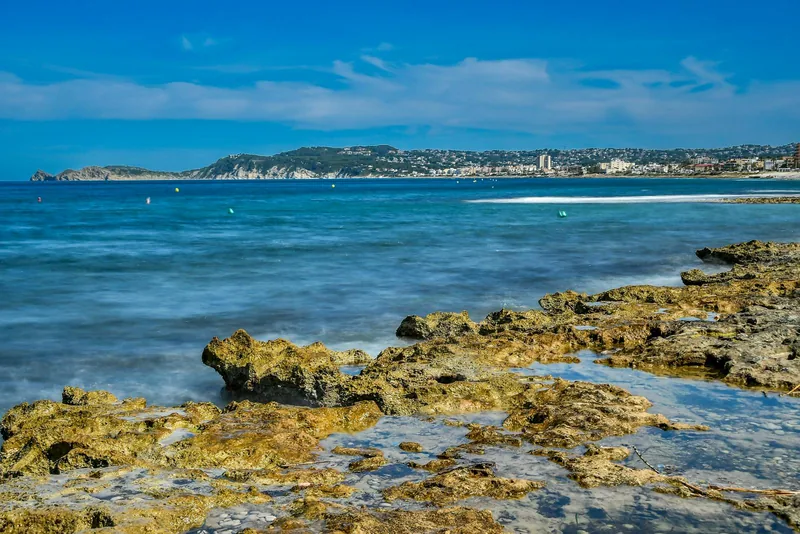
Javea's main beach, the Arenal, is the easy choice. But the most striking swimming spots in the municipality are the smaller coves cut into the limestone cliffs to the north and south of town. Almost every one of them requires a car to reach, and most reward you with crystal-clear water and a fraction of the crowds.
A short shortlist worth driving for:
- Cala Granadella. A pebble cove south of the Cap de la Nao, often ranked among the best beaches in Spain. Parking fills early, so arrive before 10 am or after 4 pm.
- Cala Portichol (Cala Barraca). Pebbly beach with a famous beachfront restaurant. Access is via a steep, narrow road from the Costa Nova area.
- Cala Sardinera. A wilder cove between the Cap de la Nao and Cala Granadella. Access involves a short walk from the road.
- Playa de la Grava. Pebble beach next to the Port, sheltered and family-friendly. Walking distance from Port restaurants.
- Playa del Primer Muntanyar. Long, narrow rocky beach south of the Arenal, with calm water and easy parking.
- Cala Blanca. Quiet white-pebble cove with snorkeling-grade water clarity.
If you only have time for one cove, make it Granadella. It is the kind of spot that ends up in your camera roll forever, and it is genuinely impossible to reach in any sensible way without a car.
Living Like a Local: Tips from the British Expat Community
Javea has been a magnet for British retirees and remote-working families for decades, and that community has accumulated a lot of practical wisdom about driving and exploring the area. Some of the best tips come straight from long-term residents who have made every possible mistake before you arrived.
A few worth borrowing:
- Refuel inland. Petrol stations in Gata de Gorgos and Ondara are often noticeably cheaper than the ones at the entrances to Javea.
- Shop at Mercadona or Aldi for the week. Both have large parking lots and are easier to access by car than the smaller Old Town shops if you are doing a serious shop.
- Use the Friday market in Jalon for wine. A 25-minute drive inland through the Jalon Valley puts you in one of the best Spanish wine regions on the coast. The Friday morning market is famous.
- Avoid the Port at lunchtime in August. Locals eat slightly later (around 2:30 pm) than tourists, and parking is easier if you adjust your schedule.
- Carry coins for blue-zone parking. Many municipal meters still prefer coins, even though most accept cards.
- Download the Javea parking apps. Several local meters now accept payment via mobile apps such as Telpark, which saves you from having to walk back to your car halfway through dinner.
- Respect siesta hours. Many smaller restaurants in the Old Town close between 4 and 7 pm. Plan your post-beach food accordingly.
- Watch for the Tramuntana wind. When the north wind blows, the sea on the north side of Javea (Port, Arenal) gets choppy. Switch to the south coves (Granadella) for sheltered swimming.
The expat community is also generous with recommendations on Facebook groups such as Javea Connect and Javea Friends. A quick search before you go can surface seasonal advice that no guidebook will give you.
How Much Does It Cost to Rent a Car in Javea?
Prices in Javea follow the broader Costa Blanca pattern, with a clear high season in July and August and noticeably cheaper rates in winter and shoulder months. A few benchmarks to set your expectations:
- April to June and September to October: Compact manual cars typically start from around 25 to 40 euros per day with full coverage.
- July and August: The same vehicles can rise to 60 to 90 euros per day, with automatics and family SUVs commanding a further premium.
- November to March: Off-season rates drop sharply, and weekly deals on a small hatchback can start from around 20 euros per day.
The real cost difference between providers comes down to what is bundled. Look for an all-inclusive rate that covers full insurance with no excess, a second driver, unlimited mileage, and (ideally) free delivery to your accommodation or to Alicante or Valencia airport. The cheapest headline price is almost never the cheapest total, once you add the supplements at the desk. Our Javea-ready fleet is priced transparently with all of these inclusions built in, which removes the unpleasant surprise of a final invoice that does not match the booking confirmation.
Frequently Asked Questions About Renting a Car in Javea
Do I need a car if I am staying in Javea for a week?
If you plan to do anything beyond your hotel beach, the answer is yes. The three main districts of Javea are too far apart for comfortable walking, public transport is limited, and the area's most beautiful coves and viewpoints are only accessible by road. A week without a car typically means missing 80 percent of what makes Javea special.
Is it better to pick up the car at Alicante or Valencia Airport?
Alicante is closer (around 90 km vs 110 km) and usually has the widest flight selection from the UK and Northern Europe. Valencia is competitive on flight prices from Central Europe and lets you combine your trip with a stop in Valencia city. Both routes use the AP-7 motorway, which is no longer tolled in this section. If your rental company offers free delivery to your accommodation, the choice of airport matters less.
What documents do I need to rent a car in Javea?
You need a valid driving license, a credit card in the main driver's name (in most cases), and a passport or national ID. EU licenses are accepted as-is. UK driving licenses are accepted for short visits. Drivers from outside the EU and EEA should bring an International Driving Permit alongside their national license. Most companies require the main driver to be at least 21 years old with one to two years of driving experience, although some set the minimum at 25.
Can I drive my rental car to France or Portugal from Javea?
Cross-border travel is usually allowed but must be declared in advance and may carry an extra fee or specific insurance. Always confirm with your rental provider before you cross the border, especially if you plan to drive into France, Portugal, Andorra, or Gibraltar. Most short Costa Blanca road trips do not require this, but it is worth knowing.
Is parking in Javea expensive?
Parking in Javea is generally affordable by Spanish coastal standards. Many municipal lots cost between 1 and 2 euros per hour, and there is a meaningful amount of free street parking outside the immediate Old Town and Arenal core. The exception is peak August, when finding a free spot near the beach before 11 am becomes genuinely difficult.
What is the best time of year for a Javea driving holiday?
May, June, September, and October are the sweet spots. The weather is warm enough for swimming, the roads are quiet, parking is easy, and rental prices are 30 to 50 percent lower than in peak summer. July and August are spectacular if you do not mind crowds, but the heat and traffic make the more ambitious driving routes less enjoyable.




%20(800%20x%20120%20px)%20(1600%20x%20200%20px).avif)