
The Costa del Sol road trip itinerary that follows turns five days behind the wheel into one of southern Spain's most varied driving experiences. You start at Malaga Airport, climb into the white-village mountains of Andalusia, sleep above a 100-metre gorge in Ronda, photograph donkey taxis in Mijas, descend into prehistoric caves in Nerja, and finish with a perfumed detour to Frigiliana before rolling the rental car back to its drop-off point. The total loop runs roughly 350 kilometres, which means most days you drive less than 90 minutes and spend the rest of the time wandering, eating, and swimming.
This guide gives you the route in the order that works best: light driving on arrival day, the longest scenic leg in the middle, and a relaxed loop back to the coast. You will find exact distances, parking tips for every stop, photo angles that work for any camera, and food recommendations from people who actually eat there. By the end you will know not just where to drive on the Costa del Sol, but when to time each town to avoid heat, crowds, and closed-shutter siesta hours.
Why a Costa del Sol Road Trip Beats Staying in One Resort
Most travellers to Andalusia arrive in Malaga, transfer to a beach hotel, and never leave the lounger. That is a mistake. The coastline is beautiful, but the soul of the region sits ten to forty kilometres inland, where mountain roads twist through olive groves and Moorish villages cling to limestone ridges. A rental car turns three or four anonymous beach days into a portrait of southern Spain: tapas in a Marbella courtyard at lunch, a sunset over the Tajo Gorge in Ronda, breakfast in a village painted entirely white, and a swim in a sea cave on the final morning.
Five days is the sweet spot. Three feels rushed. Seven means you need a longer base in Granada or Cordoba to justify the extra time. With five days you cover the western Costa del Sol, the Sierra de las Nieves, the Mijas hills, and the eastern Axarquia coast without a single boring transfer.
Best Time to Drive the Costa del Sol
The two windows that combine warm sea, manageable heat, and quiet roads are May to mid-June and mid-September to late October. Daytime temperatures sit between 24 and 28 degrees Celsius, sea temperatures climb above 20 degrees, and the mountain villages stay walkable in the afternoon instead of forcing you indoors for a long siesta. July and August work for beach lovers, but Ronda and Mijas regularly hit 36 degrees, which makes walking the cobbled lanes a sweaty endurance test. November to March is mild on the coast but unpredictable in the mountains, with morning fog that can hide the gorge views you came for.
Picking Up the Car at Malaga Airport
Malaga Airport (AGP) is the busiest in Andalusia and one of the easiest in Europe for rental pick-ups. The desks sit in the terminal arrivals hall, but the cars are parked in a covered structure a short shuttle ride away. Aim to land before midday so the queue is manageable and you can drive the short hop to Marbella in daylight. If you have not yet booked, see our complete Malaga Airport car rental guide for desk locations, shuttle directions, and the best pick-up times.
For this itinerary a compact petrol car is enough. The mountain roads to Ronda are well surfaced but tight in places, so anything larger than a mid-size SUV becomes a parking headache in Mijas and Frigiliana. Automatic gearboxes are widely available but cost more, and most rental fleets here are manual by default.
Day 1: Malaga Airport to Marbella - Picasso, Old Town, and a First Andalusian Lunch
Distance: 65 kilometres. Driving time: 50 to 70 minutes on the AP-7 toll road, or about 80 minutes on the free A-7 coastal route. Both work in May or October; in July traffic on the free road slows to a crawl.
The day begins at the airport, but the first real stop is in central Malaga, fifteen minutes from the terminal. Park at the Alcazaba underground car park for around two euros an hour and walk into the Casco Antiguo. The cobbled lanes here connect almost every postcard sight in Malaga inside one square kilometre: the Roman theatre below the Alcazaba fortress, the cathedral that locals call La Manquita because one tower was never finished, and the Picasso birthplace on Plaza de la Merced.
The Museo Casa Natal Picasso, the apartment where Pablo Picasso was born in 1881, is the smaller of the city's two Picasso institutions and the more emotional. Entry is six euros, the rooms are intimate, and the family photos and christening robes give you a sense of the boy behind the icon. If you want serious painting, walk five minutes to the Museo Picasso Malaga in the Buenavista Palace; tickets cost thirteen euros and you should book online during peak months.
Photo stop: the rooftop of the Alcazaba at golden hour. From the upper terrace you frame the cathedral spire against the harbour cranes and the Mediterranean. A wide lens or a phone panorama works perfectly.
Lunch idea: KGB Tapas just behind Plaza de la Merced for a creative tasting menu, or El Pimpi for the touristy but reliable Andalusian classics. Both sit a short walk from the car park.
By mid-afternoon point the car west and join the AP-7. Pay the toll (roughly six euros each way to Marbella) for the faster motorway, or follow the free N-340 along the coast if you have an extra hour and want to stop in Torremolinos or Benalmadena. You will reach Marbella between 4pm and 5pm, which is exactly when the old town starts to fill with locals out for a stroll.
Marbella Old Town: What to See in Two Hours
Park at the underground Parking La Alameda below the central avenue and walk uphill into the Casco Antiguo. Marbella's old town is small, white, and easy to circle on foot. Start at the Plaza de los Naranjos, an orange-tree-lined square laid out in 1485 with the town hall on one side and the chapel of Santiago on the other. From there wander the lanes south to the Castillo, the Moorish wall fragment, and the church of Santa Maria de la Encarnacion with its baroque facade.
If you collect Picasso connections, the Museo de Grabado Espanol Contemporaneo on Calle Hospital Bazan holds a small but well-curated set of his prints alongside work by Miro and Tapies. Entry is four euros and it is rarely busy. The town is also home to the Avenida del Mar, a palm-lined promenade with ten bronze Salvador Dali sculptures including the famous Gala at the Window.
Photo stop: the bougainvillea-draped alley behind the Capilla del Santo Cristo, especially in late afternoon when the white walls glow pink and the flowers backlight cleanly. Shoot wide and keep the doorway centred.
Dinner: Casa Eladio for grilled fish, La Niccoletta for fresh pasta with a sea view, or any of the tapas counters on Calle Ancha for stand-up plates and a glass of cold Manzanilla. Sleep in Marbella so you wake up close to the mountain road. The boutique Hotel Lima sits a two-minute walk from the old town, while the historic Claude Marbella in a 17th-century palace makes the splurge night memorable. For longer stays or families, our Marbella car rental hub covers local pick-up alternatives and Marbella-only deals.
Day 2: Marbella to Ronda - The Most Spectacular Mountain Drive in Andalusia
Distance: 65 kilometres. Driving time: about 90 minutes if you stop for photos, 60 minutes if you push straight through.
This is the day that converts beach travellers into mountain travellers. Leave Marbella by 9am, head west along the A-7 to San Pedro de Alcantara, then turn inland on the A-397 toward Ronda. The road climbs sharply into the Sierra de las Nieves national park, switchbacking past pine forests and limestone cliffs. The Mirador del Salto del Cabrero, a roadside pull-out about thirty kilometres in, is the obligatory first photo stop. From here on a clear morning you see all the way back to the Mediterranean and across to the Rif Mountains of Morocco.
The road requires concentration. There are tight hairpins, occasional cyclists, and the odd herd of goats. Drive sober, drive slowly, and use lower gears on the descents to spare the brakes. There are no tolls, no fuel stations for long stretches, and patchy phone reception, so fill up in San Pedro before leaving the coast.
You arrive in Ronda before noon. Park at the APK2 Plaza del Socorro multi-storey, two euros per hour and three minutes on foot from the bridge, or along Calle Marbella in the new town if you prefer free street parking and a fifteen-minute walk in. Avoid driving into the historic quarter; the streets are narrow, residents-only in places, and the satnav will route you onto pedestrian-only blocks.
The Puente Nuevo and El Tajo Gorge
Ronda's signature image is the Puente Nuevo, a stone bridge that spans the 100-metre Tajo Gorge and joins the old Moorish quarter to the newer 18th-century town. Designed by the architect Jose Martin de Aldehuela and completed in 1793 after forty years of work, the bridge looks like it was carved out of the canyon walls rather than built on top of them. There is a small interpretation centre inside one of the pillars (entry under three euros) where you can look down through grates into the gorge.
For the iconic postcard view you walk down from the Plaza Maria Auxiliadora along the path that descends into the gorge. About halfway down a wooden viewing platform lets you photograph the full arch with the Andalusian countryside framing it. The walk takes twenty minutes down and thirty minutes back up; carry water and wear shoes with grip. A separate guided path that finishes at the older Puente Viejo costs five euros and reopens after a renovation in 2026.
Photo stop: the Mirador de Aldehuela on the cliff edge above the bridge, fifteen minutes before sunset. The bridge lights come on, the limestone glows orange, and the swallows dive into the gorge. A telephoto lens compresses the bridge against the village beautifully, but a phone wide shot works too if you frame the bullring rooftops on the right.
Other Ronda highlights inside an hour's walk: the Plaza de Toros, one of the oldest bullrings in Spain (built 1785) with a small museum on bullfighting history; the Arab baths, well preserved 13th-century hammam ruins; and the Casa del Rey Moro with its 14th-century water mine cut into the cliff. Skip the bullring museum if you are short on time, but the Arab baths and water mine are both worth the four-euro entry.
Lunch and dinner in Ronda are easy. Bardal holds two Michelin stars if you want a memorable splurge; book weeks ahead. For honest Andalusian cooking try Tragatapas (Calle Nueva 4) for stand-up tapas, or Tropicana for a sit-down meal in a garden patio. Locals drink the white wines of the Ronda DO, which is a small but excellent wine region you can taste at any restaurant.
Sleep in Ronda so you wake to the silence of the gorge before the day-trippers arrive. The Parador de Ronda sits directly on the cliff edge with rooms that look across the canyon; expect to pay 180 to 240 euros in May or October. Hotel Catalonia Ronda and the smaller Hotel San Gabriel both offer character at half the price.
Day 3: Ronda to Mijas - White Village in the Sky
Distance: 75 kilometres. Driving time: 90 minutes via the A-397 back toward the coast then the A-7 east, or 110 minutes via the inland MA-485 if you want a scenic alternative through Yunquera.
Start the morning at the cliff edge while the village is still empty. The Mirador de Cuenca on the far side of the gorge gives you the bridge from a fresh angle and the Sunday market traders are usually setting up by 8am. Then drive back down the mountain. The descent to San Pedro is faster than the climb up because the gradient lets you coast in third gear; you will be on the motorway by 10:30am.
Mijas Pueblo sits 428 metres above the Mediterranean, fifteen minutes inland from Fuengirola. The approach is dramatic: a steep ascent on the A-387 with the sea always visible to the south. Park at the El Juncal car park at the edge of the village, two euros per hour, and walk in. The streets are too narrow and too pedestrianised for cars to be worth the trouble, and the walk into the village is part of the charm.
What to Do in Mijas Pueblo
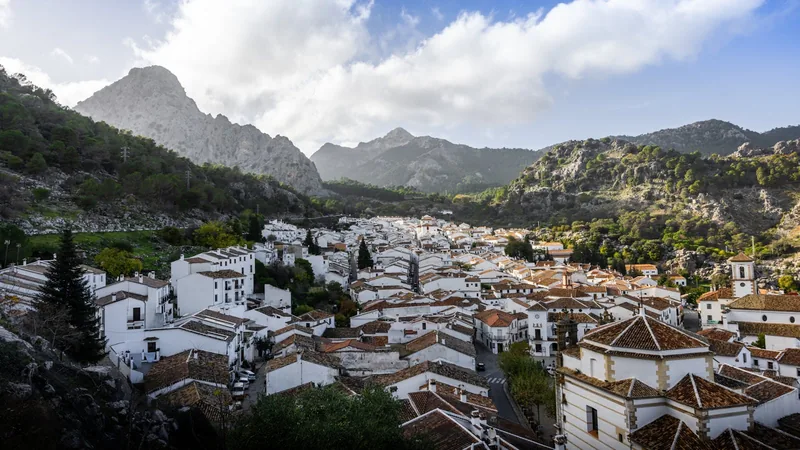
Mijas was one of the original Andalusian white villages turned tourist destination, and it shows. The streets are tidy, the souvenir shops are everywhere, and most days you share the lanes with day-trippers off coach tours. The trick is to arrive early or stay late, and to walk one block off the main square in any direction; the crowds thin out instantly and you find yourself alone with whitewashed walls and pots of geraniums.
The Mirador del Compas behind the church gives the panorama everyone comes for: the entire western Costa del Sol from Benalmadena to Gibraltar, and on a clear day the Rif Mountains across the Strait of Morocco. Walk along the old town walls toward the Plaza de Toros, a perfectly oval, almost miniature bullring built in 1900 that you can enter for four euros.
You will see the burro taxis lined up in the main square. These donkeys have been part of Mijas tourism since the 1960s, but animal welfare opinion has turned against them, and most independent travellers choose not to ride. Photograph them respectfully if you must and walk instead. The tuk-tuk taxis a few metres away offer the same circuit with no animal involved.
Photo stop: the steps of Calle San Sebastian, the village's most Instagrammed alley. Whitewashed walls, blue flowerpots, and a tiny church at the top. Shoot in late morning when the light is even but the shadows give the steps depth.
Lunch: La Alcazaba for traditional Andalusian dishes with a terrace view, or Cafe La Reja for tapas in a former carpenter's workshop. Both sit within three minutes of the main car park.
Mijas Pueblo is small. You can see the village in three hours, which means you can drive on for the night to Nerja and arrive in time for sunset. The drive from Mijas to Nerja is 90 kilometres, mostly on the A-7 motorway, and takes about 75 minutes. Alternatively, sleep in Mijas at the Hotel TRH Mijas for a quieter evening with sweeping views, and start the eastern coast leg fresh the next morning. For tighter five-day pacing, push on to Nerja the same day.
Day 4: Mijas to Nerja - Sea Caves, Balconies, and the Best Beach Day
Distance: 90 kilometres. Driving time: 75 minutes on the A-7 motorway, with a single fuel and snack stop possible at Rincon de la Victoria.
Nerja sits at the eastern edge of the Costa del Sol where the coastline starts to turn rugged and the resorts thin out. The town has a permanent population of about 22,000 but swells in summer; in May or October you find a livelier-than-village atmosphere without the crush. Park at the Plaza de Espana underground car park (two euros per hour, 24 hours) or at the Carabeo lot, both within five minutes of the main attractions.
The Cuevas de Nerja
Drive first to the Cuevas de Nerja, four kilometres east of the town centre in the village of Maro. The free car park at the cave entrance has space for around 200 cars but fills by 11am in summer; aim to arrive when the caves open at 9am or wait until 3pm when the morning tour groups have left.
The caves were rediscovered in 1959 by five local boys hunting bats, and they have been a UNESCO-worthy attraction ever since. Inside you walk a circuit of about 800 metres past chambers the size of cathedrals, including a 32-metre column that the Guinness Book of Records once listed as the largest stalactite-stalagmite pillar in the world. The interior temperature stays at 19 degrees year round, which makes the caves a perfect midday refuge in summer. Entry is 14 euros adult; allow 90 minutes including the queue.
Photo stop: the main hall, the Sala del Cataclismo. Phones struggle with the low light, so brace against a railing for sharper shots and turn off the flash, which is forbidden anyway. A small viewing terrace near the exit gives you a postcard angle out over the village of Maro and the sea.
Balcon de Europa and the Town Beaches
Drive back into Nerja and head straight for the Balcon de Europa, the palm-flanked promenade that juts out over the sea like the prow of a ship. King Alfonso XII reportedly stood here in 1885 and declared it the balcony of Europe, and the name stuck. The promenade is open 24 hours, costs nothing, and gives you 270-degree views over the Mediterranean with the Sierra de Almijara framing the eastern horizon.
From the Balcon a stairway descends to the Playa Calahonda, a small pebble cove tucked between cliffs that is one of the most photographed beaches in Andalusia. To the west, the Playa de Burriana stretches for a kilometre of golden sand and is the best beach for a real swim. Both have chiringuitos, the open-air beach bars that grill sardines on bamboo skewers right on the sand. Ayo at Playa Burriana is the legendary one; the paella, cooked over an open fire, is enough for two and costs around 25 euros a head.
Photo stop: the Balcon at sunset with the spotlight of the late sun on the Calahonda cliffs. Frame the palms on one side and the Mediterranean on the other. A vertical phone shot captures both palms and waves.
Sleep in Nerja for an early start the next morning. The Hotel Balcon de Europa sits directly above the cove, which makes the room views the best in town. For a more local feel, Hostal Caravansar or Hotel Plaza Cavana offer character and central location at lower prices.
Day 5: Nerja, Frigiliana Detour, and Back to Malaga
Distance: 75 kilometres total (Nerja to Frigiliana 7 km, Frigiliana to Malaga Airport 65 km). Driving time: 90 minutes of actual driving plus as long as you want in the white village.
The last morning starts with coffee on the Balcon de Europa while the streets are quiet. Then load the car and head north on the MA-5105, a narrow but well-surfaced road that climbs 300 metres in seven kilometres to Frigiliana. The road has plenty of pull-outs for photos of the village from below; the first viewpoint is two kilometres before you arrive and shows the cluster of white houses against the Sierra de Almijara like a model village.
Why Frigiliana Earns Its Reputation
Frigiliana has been voted the prettiest village in Andalusia by the Spanish Tourist Board and the entire old quarter was declared a historic-artistic site in 2014. The streets are narrow, cobbled, and decorated with hand-painted ceramic tiles that tell the story of the 1569 Moorish uprising. Walking the old quarter takes about an hour at a slow pace; allow another hour for a long breakfast or for browsing the artisan shops.
Park at the public car park on the Calle Real at the edge of the village (free, often full by 11am) or use the El Apero parking just below the old quarter. Walk in via the Plaza de la Iglesia where the 17th-century church of San Antonio sits, then follow the signs uphill to the Mirador del Santo Cristo for the obligatory panorama over the village rooftops to the sea.
Photo stop: the Calle Hernando el Darra steps with the cobbled mosaics underfoot and a doorway draped in jasmine. Shoot from the bottom looking up to get the steps and the village skyline in one frame. Late morning gives the best directional light without harsh shadows.
Breakfast: Bodega de Frasquita for hot churros and chocolate, or El Mirador for a full Spanish breakfast with a sea view. Both within two minutes of the El Apero parking.
The Drive Back to Malaga Airport
From Frigiliana you take the MA-5105 back down to the A-7 motorway and follow the coast west for 60 kilometres to the airport. The drive takes about 60 minutes without traffic and 90 in the Friday afternoon rush. Plan to be at the rental car return at least 90 minutes before your flight, and refuel within five kilometres of the airport to avoid penalty charges; the Repsol station at the AGP exit is the most convenient.
If you have extra time and an evening flight, detour through Malaga city for a final lunch in the old town. The drive from the city centre to the airport takes 20 minutes and the AGP car return is well signposted from every direction. For a more ambitious second week or for a longer Mediterranean trip, see our companion guide on the Costa Blanca road trip in seven days for a 500-kilometre loop further up the coast.
Practical Information for Your Costa del Sol Road Trip
Tolls, Fuel, and Driving Rules
The AP-7 motorway between Malaga and Marbella charges tolls of about six euros each way. The free A-7 follows the same coast at lower speed; in May or October the difference is twenty minutes, in August it is over an hour. Speed limits are 120 km/h on motorways, 90 km/h on rural roads, and 50 km/h in towns; cameras are plentiful and fines arrive at your rental company within weeks. Headlights must be on in tunnels and during rain, seatbelts are mandatory for every passenger, and the blood alcohol limit is 0.5 grams per litre, lower for new drivers.
Fuel is cheaper at the larger supermarket stations (Carrefour, Mercadona) and on the motorway between towns; the most expensive fuel is usually at the airport itself, so refuel ten kilometres out. Diesel and petrol both cost between 1.50 and 1.65 euros per litre in 2026.
Parking Costs and Tips
Plan for 15 to 25 euros per day in parking across the trip. Marbella, Ronda, and Nerja all have underground lots in the two to two-fifty euro per hour range, with daily caps around 18 euros. Mijas and Frigiliana have free or cheap edge-of-village parking that fills early; arrive before 10am or after 3pm to be sure of a space. Never leave valuables visible in the car at any beach car park; this is the most common type of rental car break-in on the coast.
Where to Eat Without Tourist Traps
The rule of thumb across the Costa del Sol is to walk one block away from the main square or main beach. Restaurants on the front of the Balcon de Europa, on the Plaza de los Naranjos in Marbella, or directly facing the Puente Nuevo in Ronda are the most expensive and the least authentic. The same kitchen one block back charges thirty per cent less and serves regulars instead of cruise passengers. Lunch is the cheap meal of the day: the menu del dia in any local restaurant runs 12 to 18 euros for three courses and a drink, Monday to Friday only.
Total Trip Costs for Two Adults
Budget around 1,400 to 1,800 euros for two people on a comfortable five-day Costa del Sol road trip in May or October, excluding flights. That breaks down as roughly 350 euros for the rental car including insurance, 100 euros for fuel and tolls, 100 euros for parking, 700 to 1,000 euros for four nights of three-star or boutique accommodation, and 150 to 250 euros for the cave entry, museum tickets, and small attractions. Eating well, with one tapas dinner and one menu del dia lunch a day, adds another 250 to 350 euros for two.
FAQ: Costa del Sol Road Trip Itinerary
Is 5 days enough for a Costa del Sol road trip?
Five days is the minimum to cover Malaga, Marbella, Ronda, Mijas, Nerja, and Frigiliana without feeling rushed. You drive between 60 and 90 minutes most days and have the rest of the time for exploring. If you want to add Granada or Cordoba, plan seven days. For pure beach plus one mountain town, three days work but you will miss most of the inland soul of Andalusia.
Do I need a 4x4 or SUV for this itinerary?
No. The entire route is on paved roads in excellent condition. A compact petrol car like a Seat Ibiza, Renault Clio, or Peugeot 208 handles every leg comfortably and saves you money on fuel and tolls. SUVs are oversized for the narrow lanes in Mijas and Frigiliana and make parking harder, not easier. If you want comfort for two adults plus luggage, a mid-size car like the Volkswagen Golf or Seat Leon is the upper limit before parking becomes annoying.
Can I drive this loop in winter?
Yes, but with caveats. The coast stays mild from December to February (14 to 17 degrees Celsius), and Ronda and Frigiliana are walkable on most winter days. The mountain road between Marbella and Ronda can have morning fog or occasional ice in January, especially above 900 metres. The Cuevas de Nerja are open year round and the constant 19-degree interior temperature is actually a winter highlight. Many beach chiringuitos close from November to March, but the village restaurants stay open all year.
How do I avoid traffic on the AP-7 and A-7?
The Friday evening and Sunday evening rushes between Malaga and Marbella are the worst on the entire Spanish Mediterranean coast. Plan to drive against the flow: outbound from Malaga on Friday morning, returning on Saturday or early Sunday. Mid-week is calm in any season. The AP-7 toll road is almost always quicker than the free A-7 in summer; the six-euro toll saves you 40 to 60 minutes on the Marbella-Malaga leg in July and August.
Is the road from Marbella to Ronda safe to drive?
The A-397 is a well-engineered mountain road with safety barriers on the gorge sections and clear signposting. It is not dangerous if you drive slowly, use lower gears on descents, and respect the speed advisories at the hairpins. Concentration matters more than experience. Avoid driving at night; the road has no street lighting and animals on the verge are a real risk. If you are nervous, the bus from Marbella to Ronda runs the same route in 90 minutes and gives you the views without the wheel.
Can I do this trip in reverse, starting in Nerja?
Yes. The loop works in either direction. Starting at Malaga Airport eastbound (Nerja first, Ronda last) puts the longest beach day at the start and the cliff-edge sunset in Ronda at the end, which makes a strong finale. The clockwise version in this guide front-loads the city sightseeing and saves the gentler Frigiliana morning for the last day, which most travellers prefer because you finish relaxed instead of hyped. Either way, sleep in Ronda for one night and Nerja for one night; those are the two destinations that reward an evening and a morning of unhurried wandering.
Book Your Car and Start the Drive
A Costa del Sol road trip works best when the rental car is sorted before you land. The Malaga Airport pickup desks queue up within an hour of every major arrival wave, and the cheapest cars sell out weeks ahead in the spring and autumn windows when the driving is at its best. Lock in your rental in advance, choose a compact or mid-size to keep parking simple, and you will spend the first morning sipping coffee in Malaga's old town instead of standing in a desk line.
Ready to drive? Pick up your car at Malaga Airport and start the loop today. Five days, six destinations, one of the most varied driving routes in southern Europe.




%20(800%20x%20120%20px)%20(1600%20x%20200%20px).avif)