
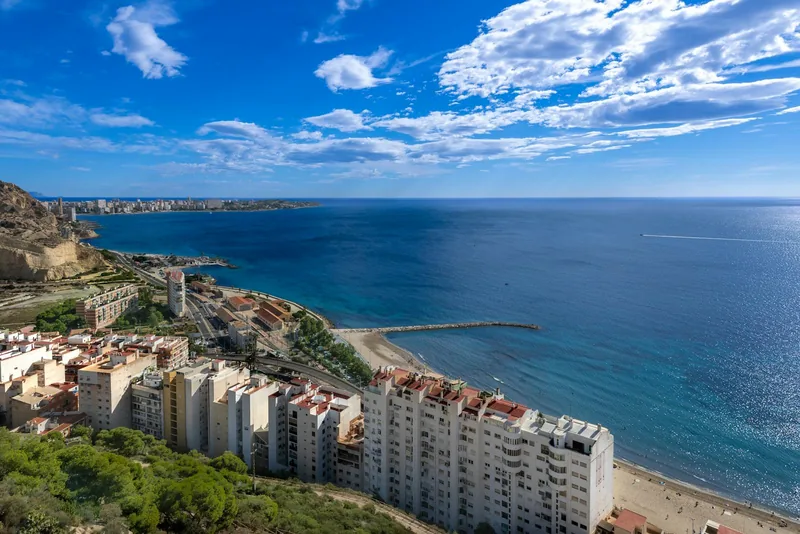
The Costa Blanca stretches for roughly 200 kilometres along the south-eastern Spanish coast, from Denia in the north to Pilar de la Horadada in the south, with the province of Alicante at its heart. Sun-bleached cliffs, hidden coves, mountain villages, salt lakes and a string of resort towns make it one of Europe's most rewarding regions to explore. To see it properly, you need a car. Public transport runs between the bigger towns, but the best beaches, the prettiest pueblos and the inland sierras are only reachable on four wheels.
This is the complete 2026 guide to Costa Blanca car rental. It covers every major destination, the best routes and road trips, what to drive, when to come, how much to budget and how to avoid the most common rental mistakes. Whether you are flying into Alicante airport for a week on the beach, planning a month-long winter escape from northern Europe or organising a self-drive tour of the whole province, you will find the answers here.
What is the Costa Blanca and why you need a car
The name Costa Blanca, literally "the white coast", was coined by British European Airways in the 1950s when it launched flights between London and Valencia. It refers to the limestone cliffs and whitewashed villages that line the shore of Alicante province. Today the region is one of the most popular holiday destinations in Spain, attracting around 13 million visitors a year, with the largest groups coming from the United Kingdom, Germany, the Netherlands, Belgium, France and Scandinavia.
The region's geography is the main reason a rental car matters. The coast is long and narrow, with two airports at either end (Alicante-Elche in the south, Valencia just to the north of the region) and dozens of resorts and villages spread between them. The motorway network is excellent, but the side roads that lead to the best coves, viewpoints and inland villages are not served by buses. Even within larger resorts like Benidorm or Torrevieja, having a car lets you escape the tourist core in the evening for a quieter dinner in a nearby pueblo.
How big is the Costa Blanca?
End-to-end driving distances give a useful sense of scale. From Denia in the north to Pilar de la Horadada in the south is around 170 km along the AP-7 motorway, roughly two hours of driving without stops. From the coast inland to the Sierra de Aitana or the Vall de Guadalest is 30 to 50 km, typically under an hour. From Alicante airport you can reach almost any major resort in 90 minutes or less, which makes day trips practical from any base.
When you actually need a rental car
You need a car if you plan to visit more than one town, want to reach quieter beaches, intend to do any inland exploring or are travelling with luggage, children or beach gear. You can probably skip it if you are staying for a long weekend in central Benidorm or Torrevieja, never leaving the resort, and using taxis or the tram for the airport transfer. For everyone else, a rental more than pays for itself in flexibility and time saved.
Top Costa Blanca destinations and where to pick up your car
The Costa Blanca is best understood as a chain of distinct destinations, each with its own character. Here is a working overview of the main bases, with notes on where to collect your rental and links to detailed city guides.
Alicante
Alicante is the provincial capital and the main entry point for the region. The historic centre wraps around the imposing Santa Barbara castle, with a long palm-lined seafront, a busy port and the Explanada de Espana promenade at its centre. The city has a working port, an old quarter, several beaches inside the city limits and a year-round local population, which makes it feel less seasonal than the pure resort towns.
Most visitors pick up rental cars at Alicante-Elche airport (ALC), 9 km south-west of the city. The airport handles around 15 million passengers a year and is the busiest hub in the Valencian Community. All major international rental companies have desks in the arrivals area, with off-site lots a short shuttle ride away. For a full breakdown of pickup procedures, parking, fuel policies and the fastest route from arrivals to your car, see our Alicante airport car rental guide.
Benidorm
Benidorm is the most concentrated resort on the Costa Blanca, famous for its high-rise skyline, two long sandy beaches (Levante and Poniente) and a nightlife scene that runs from family-friendly restaurants to British-style entertainment bars. It is 45 km north-east of Alicante airport, roughly 40 minutes by car on the AP-7.
You can collect a rental car directly in Benidorm at several downtown depots, but most travellers pick up at Alicante airport and drive in. For detailed advice on parking in Benidorm, the best neighbourhoods to stay in if you have a car, and which local depots offer the best rates, see our Benidorm car rental guide.
Torrevieja
Torrevieja sits 35 km south of Alicante airport on the Costa Blanca's southern stretch. The town grew up around its salt industry, and the famous pink lake of Las Salinas is still one of the most photographed natural features in the region. The resort has a large permanent expat population, particularly from the UK, Ireland, Scandinavia and Eastern Europe, and is known for relaxed beach living rather than nightlife.
Rental car logistics here are simple: most visitors collect at Alicante airport and drive 30 minutes south on the AP-7 or N-332. Several local rental companies also operate in Torrevieja itself. Full advice on choosing between airport and in-town pickup, and the best routes to the surrounding beaches of La Mata, Guardamar and Punta Prima, is in our Torrevieja car rental guide.
Calpe
Calpe is dominated by the Penon de Ifach, a 332-metre limestone monolith that rises straight out of the sea and shelters two long sandy beaches. The town is more upmarket than Benidorm or Torrevieja, with a strong gastronomic scene built around the local fishing port. It is 75 km north-east of Alicante airport and 55 km south of Valencia airport, putting it roughly equidistant between the two.
Almost everyone arrives by car from one of the airports. Inside Calpe, parking near the Penon and on the seafront is paid in summer but free in winter. Our Calpe car rental guide covers airport vs local pickup, the best places to park, and easy day-trip routes to nearby Altea and Moraira.
Denia
Denia is the northern gateway to the Costa Blanca, a working port town with a historic castle, a ferry connection to the Balearic Islands and a serious gastronomic reputation, holding several Michelin-starred restaurants. It is 100 km from Alicante airport and 100 km from Valencia airport, so both are valid arrival options.
The town suits travellers who want a quieter, more authentic base than Benidorm, and who plan to explore the Marina Alta region inland. For pickup advice, parking near the old town and route planning to Javea and Moraira, read our detailed Denia car rental guide.
Javea
Javea (Xabia in Valencian) lies between Denia and the Cap de la Nao, the easternmost point of the Iberian peninsula. The town is split into three parts: the historic old town a few kilometres inland, the working port and the Arenal beach and bay area. It is one of the prettiest spots on the Costa Blanca, with the cliffs of Cabo de San Antonio to the north and the limestone walls of the Cap de la Nao to the south.
Public transport between the three districts is limited, which makes a rental car almost essential. Our Javea car rental guide explains where to pick up, how to navigate the old town's narrow streets and where to park near the popular Arenal beach in summer.
Moraira
Moraira sits just south of Javea, on a stretch of coast that has been protected from high-rise development. The town has a working marina, several small coves and beaches, and a sophisticated dining scene aimed at the residential expat community. It is 80 km from both Alicante and Valencia airports.
The town's hilly geography and scattered villa neighbourhoods make driving essential for anyone staying outside the small town centre. For pickup logistics, parking tips and recommended routes, see our Moraira car rental guide.
Murcia and the southern end
The southernmost towns of the Costa Blanca, including Pilar de la Horadada, Orihuela Costa and the resorts around the Mar Menor, are closer to Murcia's Corvera airport (RMU) than to Alicante. Murcia airport handles fewer flights but is much quieter, with shorter queues and often cheaper rental rates. For full details on pickup procedures, available companies and driving times to the southern Costa Blanca, see our Murcia airport car rental guide.
Best Costa Blanca road trips and routes
The compact size of the Costa Blanca and its excellent road network make it ideal for road trips. You can do a complete loop of the coast and inland sierras in a week, or build a focused itinerary around a single region in three or four days. Here are the routes we recommend most often, with links to detailed step-by-step guides for each.
The classic 7-day Costa Blanca road trip
If you have a week, the best way to see the region is a north-to-south loop that combines the main coastal resorts with two or three inland excursions. A typical itinerary spends two nights in Denia or Javea, two nights in Calpe or Altea, and two or three nights in Alicante, with day trips inland to Guadalest, the Algar waterfalls and the Sierra de Aitana. Full driving directions, recommended overnight stops and timed itineraries are in our 7-day Costa Blanca road trip guide.
Alicante airport to Benidorm
The drive from Alicante airport to Benidorm is one of the most-driven routes on the Costa Blanca, and the choice of road makes a real difference. The AP-7 is the toll-free motorway since toll removal in 2020, fastest at around 40 minutes. The N-332 is slower but more scenic, passing through Villajoyosa with its painted houses. Our Alicante to Benidorm driving guide compares the routes, lists fuel stops and explains how to find your hotel parking in Benidorm.
Best road trips starting from Alicante
Alicante is the natural base for a wide range of day trips and overnight loops. From there you can drive to Guadalest and back in a day, do a coastal loop through Altea, Calpe and Moraira, or head inland to the wine country around Jumilla and Yecla. Our best road trips from Alicante guide ranks ten of the most rewarding options by distance, scenery and crowd level.
Self-drive Costa Blanca
For travellers who want to plan their own routes rather than follow a fixed itinerary, our Costa Blanca self-drive guide covers everything from choosing the right car class for mountain roads to navigating the narrow streets of inland villages, finding off-the-beaten-track beaches and avoiding tourist traps in peak season.
Day trips from Alicante
If you are based in Alicante for a week and want to explore without changing hotels, our day trips from Alicante by car guide lists 12 short loops you can do in a day, from the salt pans of Santa Pola to the palm groves of Elche, the castle of Villena and the inland villages of the Marina Baixa.
Costa Blanca rental practicalities
The mechanics of renting a car on the Costa Blanca are similar to elsewhere in Spain, but a few region-specific points can save you money and trouble.
No deposit car rental in Spain
One of the most common questions from visitors is whether they can rent without a large deposit blocked on their credit card. Standard Spanish rental practice is to hold between 800 and 1500 euros on a credit card for the duration of the rental, which can be a problem for travellers with low credit limits or who only have debit cards. Several companies on the Costa Blanca now offer no-deposit rentals as a standard option, usually in exchange for buying their full insurance package. Our no deposit car rental Spain guide explains how this works, what it actually costs and which companies are most reliable.
Monthly rentals for long stays
The Costa Blanca attracts large numbers of long-stay winter visitors, mainly retirees and remote workers escaping the cold in northern Europe. Monthly rental rates are dramatically lower per day than weekly rates, and several local companies specialise in flexible 28 to 90-day rentals. Typical winter monthly rates start around 350 to 450 euros for a small car, all-in. Full details on what to look for, which companies offer the best terms and how monthly rental compares to buying or leasing are in our monthly car rental Costa Blanca guide.
Insurance, excess and what you really need
Spanish car rental insurance is the single biggest source of confusion and overpayment. Basic third-party insurance is mandatory and included in every rental, but the real question is what level of damage protection to add on top. Our Spain car rental insurance explained guide breaks down the difference between CDW, super CDW, excess, deductible and zero-excess, and explains when it is worth buying the rental company's full coverage versus using third-party annual insurance from Allianz, RentalCover or a credit card.
Driving licence and documentation
EU, UK, US, Canadian and most other Western driving licences are accepted in Spain. For licences not written in Roman script (Russian, Chinese, Arabic, etc.) an International Driving Permit is recommended. The minimum rental age is usually 21, with a young driver surcharge under 25. You will need the physical driving licence, a passport or ID card, and a credit card in the main driver's name at pickup.
Fuel policy
Most Spanish rental companies use a "full-to-full" policy: you collect the car with a full tank and return it full. A few low-cost operators use "full-to-empty", where you prepay for a full tank and return the car as empty as you like. Full-to-full is almost always cheaper unless you are doing very high mileage. Fuel in Spain currently costs around 1.55 to 1.70 euros per litre for petrol and 1.45 to 1.60 for diesel, with prices about 10 cents lower at supermarket stations like Carrefour, Mercadona and BP Express.
When to visit the Costa Blanca
The Costa Blanca's climate is one of the mildest in Europe, with around 320 days of sunshine a year and average winter temperatures of 12 to 18 degrees Celsius. That said, the experience of visiting in February is very different from August, and rental prices, traffic and beach crowds vary enormously by season.
High season: July and August
July and August are the peak summer months, with average daytime temperatures of 30 to 33 degrees and sea temperatures around 25. Beaches in Benidorm, Torrevieja and Javea are packed, parking is difficult and rental prices roughly double versus the shoulder season. Booking a car six to eight weeks in advance is strongly recommended, as airport depots regularly run out of cars in August. Typical high-season rates for an economy car are 45 to 70 euros per day.
Shoulder season: April to June and September to October
The shoulder months offer the best balance of weather, prices and crowds. Spring sees daytime temperatures of 20 to 26 degrees, almond and orange blossom inland, and rental rates around 25 to 40 euros per day. September is arguably the best month overall: the sea is still warm from summer, the crowds have left and prices have dropped sharply. October is similar but with slightly cooler evenings.
Low season: November to March
Winter on the Costa Blanca is the warmest in mainland Europe outside southern Andalucia, with daytime temperatures of 15 to 20 degrees and very low rainfall. The region attracts a huge population of winter migrants from northern Europe, many on monthly or seasonal rentals. Daily rates can drop to 12 to 20 euros for a small car, and monthly rates start around 350 euros all-in. The trade-off is that the sea is cold (14 to 16 degrees), some beach restaurants close in January and February, and you will need a light jacket in the evening.
Prices by month
As a rough guide for an economy car rented at Alicante airport for a week, expect:
- January-February: 90 to 140 euros per week
- March: 110 to 170 euros per week
- April-May: 140 to 220 euros per week
- June: 200 to 320 euros per week
- July-August: 350 to 550 euros per week
- September: 200 to 320 euros per week
- October: 140 to 220 euros per week
- November-December: 100 to 160 euros per week
These ranges assume booking three to six weeks in advance with a recognised broker. Last-minute August rates can be much higher.
What car to drive on the Costa Blanca
Choosing the right car class makes a real difference to your trip. The Costa Blanca's terrain is varied, with motorway driving along the coast, narrow village streets inland, mountain hairpin bends in the sierras and parking that ranges from generous to almost impossible. Here is how to choose.
Small hatchback: the default choice
For most visitors, a small hatchback in the Fiat Panda, Kia Picanto, Hyundai i10 or VW Polo class is the ideal rental. They are easy to park in narrow village streets, cheap on fuel, comfortable enough on motorway runs and adequate for two adults plus luggage. Typical rate: 18 to 35 euros per day in shoulder season.
Compact: extra comfort for road trips
If you are planning longer driving days or have three or four passengers, step up to a compact class car like the Renault Clio, Peugeot 208 or VW Polo. The extra interior space and better motorway stability are worth the small price difference. Typical rate: 25 to 45 euros per day.
Estate or compact SUV: families and long trips
For families with luggage, beach gear and pushchairs, an estate (Skoda Octavia, Seat Leon ST) or compact SUV (Renault Captur, Peugeot 2008) gives the most usable space. SUVs offer slightly higher seating, which makes mountain roads more comfortable, but they are not necessary for any Costa Blanca road. Typical rate: 35 to 60 euros per day.
Convertible: a luxury for spring and autumn
The Costa Blanca's coastal roads, particularly the N-332 between Calpe and Altea, are made for top-down driving. A convertible Mini, Fiat 500C or Mazda MX-5 is a memorable choice in April, May, September and October. In high summer it is often too hot to enjoy. Typical rate: 50 to 100 euros per day.
Automatic or manual?
Around 65 per cent of cars sold in Spain in 2025 were automatic, but rental fleets still skew towards manual transmissions, particularly in lower price classes. If you need an automatic, book early and expect to pay 5 to 15 euros more per day. Mountain roads in the inland sierras have many hairpin bends, and an automatic transmission reduces fatigue on longer drives.
Local tips for driving on the Costa Blanca
A few practical tips from people who drive these roads daily.
Parking
Parking in coastal resorts in high summer is the single biggest day-to-day challenge. The rule of thumb: blue lines mean paid parking (typically 1 to 2 euros per hour, free overnight and on Sundays), white lines mean free parking, yellow lines mean no parking and red lines mean no stopping at all. Most resorts have free parking lots on the outskirts with a 10 to 15-minute walk to the beach. Apps like ElParking and Parkimeter let you pay for blue-zone spaces from your phone and avoid hunting for a working meter.
Toll roads
The AP-7 motorway, the main coastal artery from Valencia to Alicante and beyond, became toll-free in January 2020. There are now no toll roads anywhere on the Costa Blanca. The only remaining tolls in the region are the AP-7 north of Valencia (Sagunto towards Tarragona) and the AP-36 inland link from La Roda to Ocana, neither of which most Costa Blanca visitors will use.
Speed limits
Standard Spanish speed limits apply: 120 km/h on motorways (autopistas, AP and A roads), 90 km/h on secondary roads, 50 km/h in towns and 30 km/h in residential zones. Speed cameras are clearly signposted on motorways but more discreet in towns. Fines for speeding start at 100 euros and rise steeply.
Fuel stations
Fuel is widely available, with stations open 24 hours along the AP-7 and in main towns. The cheapest fuel is at supermarket stations: Carrefour, Mercadona Energy, BP Express and the BonArea group. The most expensive is at Repsol, Cepsa and other branded stations on the motorways. The price difference can be 10 to 15 cents per litre, which adds up over a long trip.
Expat and long-stay tips
The Costa Blanca has one of Europe's largest expat populations, and several services are tailored to long-stay visitors. If you are spending more than two weeks in the region, consider getting a Via-T transponder (free from most banks) which lets you use the automatic toll lanes elsewhere in Spain, even though Costa Blanca itself has no tolls. The Repsol Waylet app and Cepsa Pay app give 3 to 5 per cent discounts on fuel at their respective stations. For winter visitors, supermarket loyalty cards (Carrefour, Consum, Mercadona) pay for themselves quickly.
Local navigation
Google Maps and Waze both work reliably across the Costa Blanca. Waze tends to be better for live traffic in summer, while Google Maps is better for parking suggestions and points of interest. Mobile coverage is excellent everywhere on the coast and good in most inland villages.
Beach access and reaching small coves
Many of the Costa Blanca's best beaches are small coves reached by narrow access roads that end in small free or low-cost car parks. Examples include Cala Granadella in Javea, Cala Llebeig between Javea and Moraira, and Cala del Moraig in Benitachell. These fill up by 10am in July and August. Arriving before 9am or after 6pm is the practical solution.
Inland mountain driving
The inland sierras (Sierra de Bernia, Sierra de Aitana, Sierra de Mariola) have spectacular driving roads with frequent hairpin bends. The roads are well-maintained but narrow in places. Allow more time than Google Maps suggests, take it slowly, and use the horn at blind corners on the tightest sections. Driving these roads in a small or compact car is more enjoyable than in a large SUV.
Costa Blanca car rental FAQ
Where is the best place to rent a car on the Costa Blanca?
For most visitors, Alicante-Elche airport is the best pickup point. It has the largest choice of companies, the most competitive prices and is within 90 minutes of every major resort on the Costa Blanca. Travellers heading specifically to the southern coast (Orihuela Costa, Mar Menor) may find Murcia airport more convenient. For long stays, picking up at a downtown depot in Benidorm, Torrevieja or Denia can be cheaper than the airport.
How much does a rental car cost on the Costa Blanca?
Budget for 15 to 25 euros per day for a small car in winter, 25 to 40 euros per day in spring and autumn, and 45 to 70 euros per day in July and August. Monthly rates from 350 euros all-in are widely available outside the summer peak. Add about 30 per cent for an automatic, 20 to 40 per cent for full insurance with zero excess.
Do I need an International Driving Permit?
No, if your licence is written in Roman script (English, Spanish, French, German, Dutch, Scandinavian languages) you do not need an IDP for car rental in Spain. UK, US, Canadian, Australian, New Zealand and EU/EEA licences are all accepted. If your licence uses non-Roman script, an IDP is recommended and sometimes required.
Is the AP-7 motorway free on the Costa Blanca?
Yes. The AP-7 between Valencia and Alicante (and continuing south to Cartagena) became completely toll-free on 1 January 2020. There are no toll roads anywhere within the Costa Blanca region. The only toll motorway you might encounter on a trip from Costa Blanca is the AP-7 north of Sagunto, heading towards Barcelona.
Can I rent a car at one airport and return it at another?
Yes, but one-way rentals between Alicante and Valencia airports usually carry a fee of 30 to 80 euros. Within the same airport network (Alicante to Murcia, or Valencia to Alicante through certain brokers) the fee can sometimes be waived in shoulder season. Always check the one-way fee when comparing prices.
Is it safe to leave a rental car parked overnight?
Generally yes. Costa Blanca crime rates are low, and overnight street parking is normal in most towns. Sensible precautions apply: never leave visible valuables in the car, use a hotel or apartment garage if available, and avoid isolated lots in town centres at night. Insurance covers theft of the car itself but rarely covers personal belongings.
What is the best month to drive the Costa Blanca?
May, June, September and October offer the best combination of warm weather, manageable traffic and reasonable prices. September is the consensus favourite among regulars: warm sea, fewer crowds and rental prices that have dropped sharply from August. November to February is best for monthly rentals and quiet exploration, with the only trade-off being a cold sea.
Do I need an SUV or four-wheel drive?
No. Every road worth driving on the Costa Blanca is fully paved and accessible to a normal hatchback. SUVs offer more boot space and a higher seating position, which some drivers prefer, but they are not mechanically necessary for any route. Small and compact cars are easier to park in inland villages and use less fuel.
Ready to book your Costa Blanca rental car?
The Costa Blanca rewards travellers who take the time to explore it properly. With a rental car you can spend mornings on the beach, afternoons in mountain villages, evenings at a port restaurant in Denia or Javea, and return to a different base every night if you choose. The combination of warm climate, excellent roads, varied scenery and low driving stress makes it one of the easiest regions in Europe to road-trip.
At WeOneRent we focus exclusively on the Costa Blanca, with a curated fleet of well-maintained cars covering every size class from city runabouts to family estates and convertibles. We offer transparent pricing with no hidden fees, no deposit options on most cars, and flexible monthly rentals for long-stay visitors. To see the full range and check live availability, visit our cars page or contact us directly for advice on the right vehicle for your trip.
Whatever you choose, the most important booking advice is the same: book early, especially for July and August, and read the rental terms carefully. With a little preparation and the right car, the Costa Blanca opens up as one of Europe's most rewarding self-drive destinations.




%20(800%20x%20120%20px)%20(1600%20x%20200%20px).avif)