
Demand for SUV hire in Spain has grown steadily over the last three years, and in 2026 it has become one of the most-searched vehicle categories on Spanish car rental platforms. The reasons are straightforward: more luggage space, higher seating position, automatic gearbox as standard on many models, and a driving position that suits families and older travellers who find getting in and out of a low compact difficult. What the search results rarely tell you is what SUV hire in Spain actually costs once surcharges are counted, which SUVs you are realistically likely to receive, and whether the upgrade over a compact or economy car is worth it for your specific trip. This guide answers all three questions honestly.
What "SUV" means in the Spanish car hire market
Car hire classification in Spain - as everywhere in Europe - uses the ACRISS code system. The SUV category is not a single model: it is a size and body-style bracket that includes crossovers and compact SUVs from Seat, Volkswagen, Hyundai, Kia, Toyota, Renault and others. What all of these models share is a raised ride height compared to a regular hatchback, a boot large enough for three or four large suitcases, and - at the modern end of the fleet - some form of automatic or semi-automatic transmission.
What "SUV" does not mean in the Spanish rental market: full-size off-road vehicles, seven-seat versions, American-style large SUVs or performance-oriented models. You will not find a Toyota Land Cruiser, a Ford Explorer or a Range Rover in a standard rental category. When you book "SUV" in Spain, you are booking a compact to mid-size crossover in the 4.1 to 4.6 metre range. If you need seven seats, you would need a people-carrier or minivan category - and you should check availability at your specific location before booking, because these are far less common in Spain than the standard five-seat SUV.
What SUVs are actually available at Spanish airports
At Alicante-Elche Airport (ALC), Murcia International Airport (RMU) and the major airports in Valencia, Madrid and Barcelona, the main rental chains - Goldcar, Centauro, Record Go, Europcar and Sixt - all carry SUVs. The models most frequently assigned in the compact SUV category are the Seat Arona, Seat Ateca, Volkswagen T-Roc, Volkswagen Tiguan, Hyundai Tucson and Kia Sportage. Availability of specific models varies by airport, season and booking lead time, and under ACRISS rules you are guaranteed the category, not the specific vehicle.
At the budget end of the SUV category, the vehicles are typically the smaller crossovers: the Seat Arona, Hyundai Kona or Peugeot 2008. These offer a slightly raised driving position and better luggage access than a supermini, but they are not significantly larger than a well-specified compact hatchback in practical terms. If boot space is your priority, confirm the specific model when booking or go to a company that commits to a named model rather than a category.
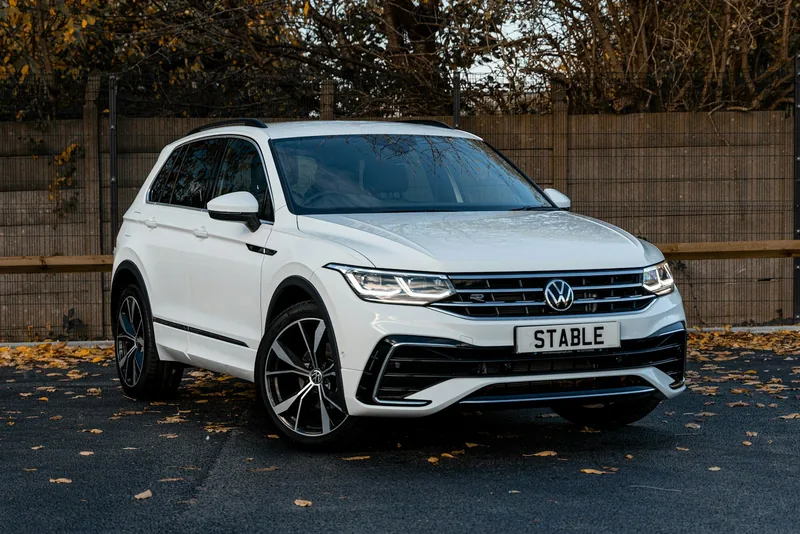
Local rental companies in Alicante generally carry fewer vehicles in the SUV category than airport chains, but what they do carry is usually a mid-size model. At WeOneRent, the sole SUV in the fleet is a Volkswagen Tiguan - a vehicle we commit to rather than using as a filler in a broader category promise.
The VW Tiguan: the benchmark compact SUV in Spain
The Volkswagen Tiguan is the most widely rented non-budget SUV in southern Spain and has been the benchmark compact crossover for most of the past decade. The current generation measures 4.51 metres in length, offers 521 litres of boot space with rear seats up (expanding to over 1,600 litres with the rear bench folded), and seats five adults with genuine rear-seat legroom - something the smaller crossovers cannot always claim.
The Tiguan's relevance to the Spanish rental market: it is large enough to handle two weeks of luggage for a family of four, comfortable on the AP-7 motorway at cruise speed, and compact enough to park in most Spanish town centres without requiring a dedicated large-vehicle bay. It is not a prestige or luxury car - it is a practical, well-built mid-size SUV that works across the range of Costa Blanca itineraries, from airport to resort to mountain roads and back.
For automatic transmission availability - which the Tiguan frequently offers as DSG option or standard equipment - see our detailed guide to automatic car hire in Alicante.
Real prices: what SUV hire in Spain actually costs
The headline prices for SUV hire in Spain that appear on broker comparison sites are seasonal minimums and rarely reflect what you will pay once insurance, deposit and fuel policy are included. This is not unique to the SUV category, but the gap between headline and checkout total tends to be larger on SUVs because the absolute amounts are higher.
For a rough sense of the market: independent data from comparison platforms in mid-2026 puts the average daily rate for an SUV in Alicante at around EUR 35-45 per day before insurance is added. In peak July and August that average rises significantly; in January and February it falls below EUR 30 per day from some providers. These are base rates. The total cost of the rental - once you add CDW, any deposit handling fee for excess cover, fuel and any optional extras - is a different number. Use the checkout total for a genuine comparison, not the headline figure.
| Booking type | Low season (Nov-Mar) | Mid season (Apr-Jun, Sep-Oct) | High season (Jul-Aug) |
|---|---|---|---|
| Airport chain, basic cover | From EUR 200-280/week | From EUR 300-420/week | From EUR 450-700+/week |
| Airport chain, full cover included | From EUR 300-420/week | From EUR 430-580/week | From EUR 580-900+/week |
| Local company (e.g. WeOneRent) | Check widget | Check widget | Check widget |
These are directional ranges based on publicly available booking data, not guarantees. Prices fluctuate with demand, booking lead time and fuel costs. The airport chain figures assume you select the minimum or full insurance option at checkout. For a full explanation of how Spanish car hire insurance works, including what an excess actually means and how the four cover tiers differ, see our guide to car rental insurance in Spain.
The real cost of an SUV over an economy or compact is typically EUR 100-200 per week in absolute terms depending on season and company. Whether that premium is worth paying depends on what you gain - which the next section addresses directly.
SUV vs compact vs economy: an honest comparison
| Factor | Economy (Peugeot 208 class) | Compact (Peugeot 308 class) | SUV (VW Tiguan class) |
|---|---|---|---|
| Boot space (litres) | 200-280 | 300-420 | 500-600 |
| Rear seat legroom | Adequate for short trips | Comfortable | Comfortable for 4 adults |
| Ride height | Low | Low to medium | Raised - easier entry and exit |
| Fuel cost in Spain | Lowest | Medium | Higher (larger engine, more weight) |
| City parking | Easiest | Easy | Manageable - check car park height |
| Mountain driving comfort | Adequate | Good | Best - torque, clearance, stability |
| Large suitcases (standard 67cm) | 2 | 3 | 4-5 |
| Weekly premium over economy | - | EUR 50-100 | EUR 100-200 |
When SUV hire is worth it - and when it is not
The SUV category earns its premium in specific scenarios. It is hard to justify in others.
Book an SUV when:
- You are travelling as a family of four with a pushchair, sports equipment or multiple large suitcases. The boot space difference between an economy car and a Tiguan-class SUV is the difference between fitting everything and leaving something behind.
- You plan to drive mountain roads - the Guadalest valley, the Jalon valley above the Costa Blanca, the Sierra Nevada, or the inland roads behind Alicante and Murcia. The raised ride height and torquier engines handle sustained climbs and descents with noticeably less effort than a supermini.
- One or more passengers has limited mobility. Getting into and out of a raised vehicle is significantly easier than getting out of a low hatchback seat after a three-hour drive.
- You are travelling with four adults and the trip involves more than one day of driving. The rear seat in a VW Tiguan gives proper legroom; the rear seat in a Peugeot 208 does not for adults above average height.
- You want automatic transmission and your dates fall in peak summer. Automatic SUVs are more consistently available than automatic economy cars, particularly at local companies whose fleets lean toward the mid-size range.
Do not pay the SUV premium when:
- You are travelling as a couple with carry-on luggage. A compact hatchback fits two bags and two passengers with room to spare, and saves you EUR 100-200 per week.
- Your entire trip stays within Alicante city and a 30-kilometre coastal radius. Urban driving in an SUV costs more in fuel and is harder to park in the older narrow streets of coastal Spanish towns.
- You only need the larger vehicle for the airport run to fit luggage. Book a compact, use a trolley at the airport, and spend the difference on activities.
- The SUV available is one of the smaller crossovers - Seat Arona, Hyundai Kona - and your real need is boot space. These are only marginally larger than a compact hatchback in practical terms. Check boot dimensions before upgrading.
Luggage capacity: the practical case for SUV hire
Boot space is the single most common reason people book an SUV in Spain, and also the most misunderstood. The key numbers: a Volkswagen Tiguan offers 521 litres of boot space with rear seats up. A Peugeot 308 offers approximately 412 litres. A Peugeot 208 or similar economy class car offers around 265-280 litres. In practical terms: a family of four with a week of luggage, beach equipment and a pushchair will fill an economy boot and struggle with a compact. The same family in a Tiguan has room to spare.
One nuance worth knowing: boot space figures in manufacturer specs assume all seats are up and the space is filled to the parcel shelf. Real-world suitcases with irregular shapes fill more awkwardly than the litre figure implies. The SUV advantage over the compact is real but slightly less dramatic than the spec sheets suggest. If you have four hard-shell large suitcases plus four carry-ons, test-pack before the trip or add a roof bag rather than relying on the numbers alone.
For context on how our economy and compact models compare on boot space, see our guide to economy car hire in Alicante.
City driving and parking: the honest picture
SUVs are manageable in Spanish city centres but they are not optimised for them. In Alicante city, the road widths in the Ensanche district and along the seafront are wide enough for an SUV without stress. The old town near Santa Barbara Castle and the narrow streets of the Santa Cruz barrio are tighter - navigable but slow, and the Tiguan's 1.84-metre width requires attention in the narrowest sections.
For car parks: the Tiguan's roof height of 1.67 metres clears the standard 1.90-metre minimum on most Costa Blanca car parks without issue. Underground car parks in older Spanish city centres sometimes have lower clearance limits - check the signage at the entrance and do not rely on GPS listings, which are not always accurate about vehicle size restrictions.
For towns like Altea, Moraira and Calpe - popular on the northern Costa Blanca - the old quarters have streets that were designed for narrower traffic. Take the SUV to the edge of the old town, park in the nearest municipal car park, and walk. This applies to a compact too, but the SUV requires more care when reversing.
Low emission zones and SUVs: what renters need to know
Spain has rolled out low emission zones (Zonas de Bajas Emisiones, ZBE) in cities across the country, most significantly in Madrid and Barcelona. A common concern among SUV renters is whether their larger vehicle will be restricted in these zones.
The short answer: rented SUVs are almost always compliant. Access to Spanish ZBEs is determined not by vehicle size but by the DGT environmental label, which classifies vehicles by engine type and emissions. Any car in a legitimate Spanish rental fleet in 2026 - SUV or economy - carries a DGT label (look for the coloured sticker on the windscreen). Modern petrol SUVs carry the green or yellow label; diesel SUVs from 2015 onwards typically carry the green label. Both have access to ZBE areas during normal restricted hours. The only vehicles excluded are those with no label at all - pre-2001 petrol cars and pre-2006 diesels - which are not in current rental fleets.
For full detail on which zones operate where and what the access rules are for different label types, see our dedicated guide: LEZ and ZBE car rental guide for Madrid and Barcelona.
SUV hire for families: what actually matters
Families with children are the largest single group booking SUVs in Spain, and for most of them the category makes unambiguous sense. The specific advantages:
Child seat installation: ISOFIX points are standard on the Tiguan and most mid-size SUVs. The higher floor height makes clicking and securing a child seat significantly easier than in a low hatchback, and checking belt tightness is simpler when you are not crouching. At WeOneRent, child seats are available for 42 EUR or 36 EUR per rental depending on age group - confirm type and availability when booking.
Getting toddlers in and out: the time this takes across a two-week holiday with multiple daily trips adds up. The raised seat height of an SUV makes this noticeably faster than the equivalent in a low economy car.
Pushchair and buggy storage: a folded pushchair takes a meaningful fraction of an economy boot. In a Tiguan, it sits in the boot without affecting access to anything else. On trips where the pushchair goes in and out frequently, this matters more than it sounds in advance planning.
For longer family stays of one month or more, our long-term packages offer a better total cost than day-rate booking. More on that in our long-term car rental Alicante guide.
WeOneRent and the VW Tiguan in Alicante
WeOneRent runs a fleet of economy and compact cars from Alicante city, with free meet and greet at ALC airport between 08:00 and 20:00 and free delivery across the city. The one SUV in the fleet is a Volkswagen Tiguan.
We do not use the Tiguan as a category placeholder. It is a named model you are booking, not a "Tiguan or similar" promise that becomes a Seat Arona at handover. If it is available on your dates, you know exactly what you are getting. If it is not available, we say so at the search stage rather than confirming a booking and substituting at pickup.
WeOneRent holds a 5.0 rating on Google based on 104 reviews and a 4.6 rating on Trustpilot. We accept debit cards, offer four insurance tiers including a zero-deposit full-cover option, and charge no additional fee for a young driver using the Tiguan beyond the standard 9 EUR per day young driver supplement. See the full fleet on our cars page, or compare all types of providers in our comparison of car rental companies in Alicante.
How to book an SUV in Spain without the surprises
The booking steps that prevent the most common problems with SUV hire:
- Confirm the model, not just the category. "SUV" on a broker search might mean a Seat Arona (4.08 m, 355-litre boot) or a VW Tiguan (4.51 m, 521-litre boot). These are different vehicles with meaningfully different luggage capacity. If boot space is the reason you are upgrading, confirm the specific model before paying.
- Check the transmission. Many SUVs in Spain are available in both manual and automatic. If you want automatic, filter for it specifically. Do not assume the SUV category means automatic.
- Read the fuel policy. Full-to-full is the most transparent option: you receive a full tank and return the car full. Pre-paid fuel options that look cheaper upfront typically cost more if you return with fuel remaining. Full-to-full is consistently better for trips of one week or more.
- Compare checkout totals, not headline prices. A slightly higher headline rate from a company that includes full insurance is almost always cheaper than a low headline rate with a EUR 1,500 excess sitting on your credit card.
- Book ahead for summer. SUV availability at Alicante tightens significantly in July and August. At local companies and at airport chains, the better-specified SUVs are booked weeks or months in advance. If your trip is in peak season, book as early as you can.
FAQ: SUV hire in Spain
Is SUV hire always more expensive than compact in Spain?
In most seasons and for most booking types, yes - but the gap varies. In low season the difference can be as small as EUR 50-80 per week at some providers. In peak summer it can reach EUR 200 per week or more. Always compare the full checkout total including insurance and deposit handling, since these sometimes matter more than the car category base rate.
What SUV models can I expect at Alicante airport?
The most common models at ALC in 2026 are the Seat Arona, Seat Ateca, VW T-Roc, VW Tiguan, Hyundai Tucson and Kia Sportage. Which model you actually receive depends on the company, the season and their stock at pickup time. Under ACRISS rules you are guaranteed the category, not the specific model. If the exact model matters, book with a company that commits to a named vehicle.
Can I take a rented SUV off-road in Spain?
Standard rental SUVs in Spain - including the VW Tiguan in standard specification - are not equipped or authorised for true off-road driving. They handle unpaved tracks and rough rural roads without difficulty, but driving on genuinely off-road terrain where you might get stuck violates most rental agreements and would make you liable for recovery costs and damage. Stick to surfaced roads, including unmarked agricultural tracks, and you will be fine.
Do I need a special licence to hire an SUV in Spain?
No. Any standard Category B driving licence covers all compact and mid-size SUVs including the VW Tiguan. There is no separate SUV category or licence requirement. If you hold a non-EU licence, carry an International Driving Permit alongside it. See our complete driving in Spain guide for licence requirements by country of origin.
Will an SUV fit in Spanish car parks and underground garages?
Most will, yes. The VW Tiguan's roof height of 1.67 m clears the standard 1.90-metre minimum on the overwhelming majority of Costa Blanca car parks. Underground garages in older city centres occasionally have lower clearances - check the signage at the entrance. Parking structures built after 2000 almost universally offer 2.0 m or more headroom.
Is the VW Tiguan available as automatic at WeOneRent?
The Tiguan is available in both manual and DSG versions depending on the specific unit in the fleet. Whether the car available on your dates has manual or automatic gearbox depends on current stock. Contact us on WhatsApp at +34 607 442 437 before booking and we will tell you directly - we do not guess or promise what we cannot confirm.
Ready to check whether the Tiguan is available for your dates? See live prices and book at weonerent.es. If you have specific questions about luggage space, transmission or delivery, message us on WhatsApp - no booking required to ask.




%20(800%20x%20120%20px)%20(1600%20x%20200%20px).avif)